The Car Park With a Lake: Six Motorway Services Worth Stopping For
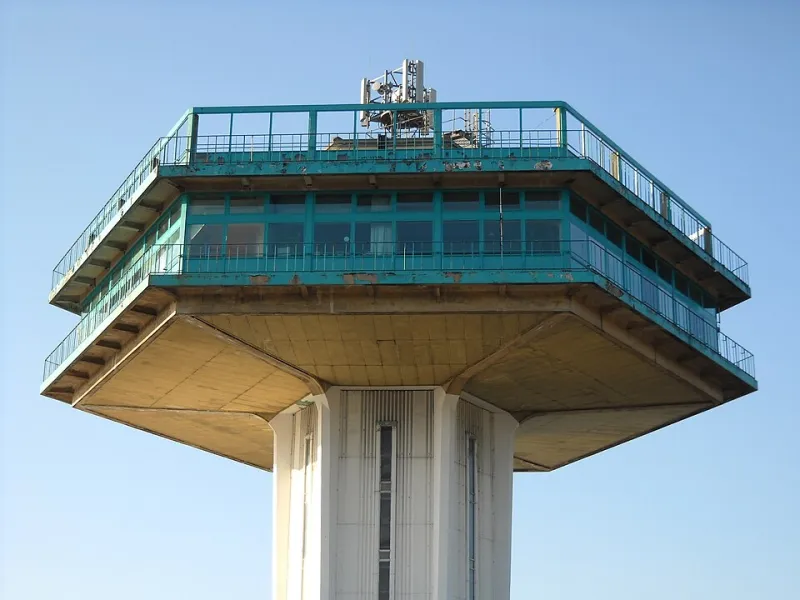
Photo: Bungalow-build, CC BY-SA 4.0, via Wikimedia Commons
Nobody puts a service station on a list of places they'd like to go. It exists in the British imagination as a fluorescent-lit holding pen: the smell of fried food, the queue for the loo, the dispiriting knowledge that you're only halfway there. We pass through them the way we pass through a tunnel — eyes forward, no interest in the walls.
Which is a shame, because a motorway service area is the only building most of us will ever enter in a place we can't name. It is also, in its own odd way, one of the last unclaimed attractions in Britain. Free to enter. Open when everything else is shut. Built, some of them, with real ambition.
The Prehistory of the Roadside
Britain's first motorway services opened in 1959 at Watford Gap and Newport Pagnell, and the early ones came with a swagger. Restaurants were built on bridges over the carriageway, so that eating a plate of eggs became a form of theatre. Later decades added cladding, arcades, and the great homogenisation. Then, somewhere in the 2000s, something turned: a handful of operators started building places people might genuinely choose.
That's the useful shift. If you're prepared to give a service station two hours instead of fifteen minutes, a strange thing happens — it becomes a short break. Here are six where it's worth leaving the car.
Tebay, M6 Junction 38
The one that started the revival, and still the benchmark. Family-run since the early 1970s, sitting in a fold of the Lune gorge with the fells pressing in on both sides. The farm shop is the draw — proper bacon, local chutneys, a butcher's counter that would embarrass most high streets — but the real reason to linger is the setting. The site's edges give onto rough grazing, and there's a duck pond, a caravan park next door, and enough grass to eat a sandwich on without staring at a number plate.
Killington Lake, M6 Junction 37
Fifteen minutes south of Tebay, and a completely different proposition. The car park sits above a small lake, and the view from the terrace — water, then trees, then the Howgills beyond — is better than plenty of paid attractions. There's a short path down to the water and around part of the shore, which is enough to clear your head and remind you that Cumbria is not, in fact, only a series of cones.
Gloucester, M5 Junctions 11a and 12
The grand statement of the modern era. A grass roof, a hillside setting, and a building that seems deliberately designed to look like it grew there rather than landed. Inside, the butchery and deli counters do serious local trade; outside, the planting is generous enough that you can walk a loop of the site and feel like you've been somewhere. It's the sort of place where people nip in for milk and come out with a pork pie and a sense of civic wellbeing.
Severn View, M48 Junction 1
A neglected gem on a neglected motorway. The M48 is the old Severn crossing route, now so quiet you can drive it at a steady 70 while the M4 next door grinds to a halt. The services sit high above the estuary with the original bridge in full view — a genuinely spectacular piece of engineering to look at while holding a tea. Better still, the southern end of the Offa's Dyke Path starts close by at Sedbury Cliffs, so you can walk a mile of a National Trail before getting back in the car.
Newport Pagnell, M1 Junctions 14 and 15
A history lesson with parking. One of the first two service areas in the country, and still wearing its 1960s bones under the later additions — look for the footbridge over the carriageway and the shape of the original buildings beneath the signage. It is not beautiful. It is, however, a listed-in-spirit monument to a moment when Britain decided the future would be concrete, and there's something bracing about that.
Skelton Lake, M1 Junction 45
The new one, opened in 2020, and proof the idea is still evolving: heavy timber structure, big windows, and a lake outside with a path running around it. It's a genuine bit of wetland on the edge of Leeds, with birds on the water and a walking loop that takes about as long as a coffee. Come at dusk and the whole thing looks far too good for a junction.
How to Do It: The Two-Hour Method
Most UK service areas offer a couple of hours of free parking, and that's your budget. Spend it properly.
Park at the far end. Everyone circles the doors. Go to the outer reaches of the car park and walk in — you immediately get a sense of the site's shape, and often a better view than the smokers' corner.
Walk the perimeter before you go inside. Look for the waymark discs, the footpath sign, the gate in the hedge, the lake path. Almost every one of these sites has a walkable edge that ninety-nine per cent of visitors never see.
Buy the local thing. The point of a good services is that it's a shop for the region it happens to be in. If the shelves could be anywhere, you're in the wrong one.
Eat last. Coffee at the end, not the start. Otherwise the two hours disappear into a table.
Avoid Friday teatime and bank holiday Mondays. Obvious, but the difference between a wander and a scrum.
What You Get Out of It
Not a day out, exactly. Something smaller and more useful: a reminder that the journey contains places as well as distance. You stop for fuel and end up watching a heron on a lake, or standing above the Severn with a National Trail at your back, or buying a pork pie with a hillside attached to it.
Seeing the familiar differently doesn't require a plane ticket. Sometimes it requires nothing more than pulling off at junction 12 and giving the place the twenty minutes it's never been offered.