The Accidental Atlas: A Field Guide to Britain's Town-Twinning Signs
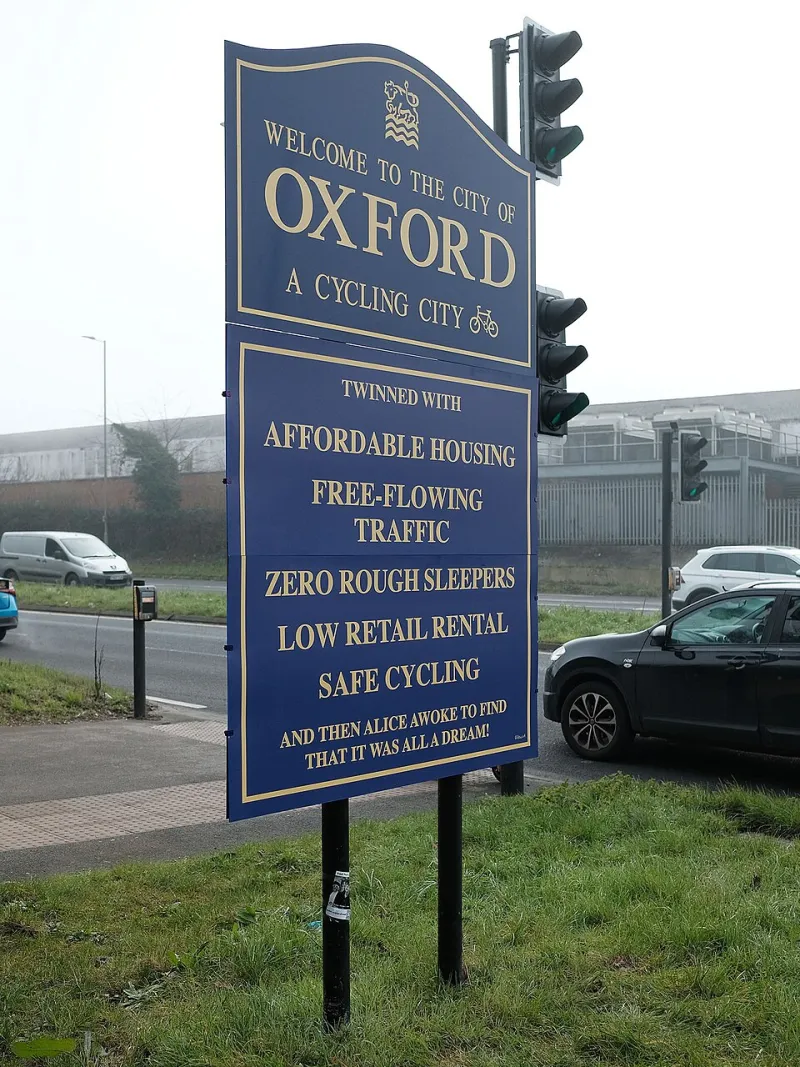
Photo: Polly Kiersten, CC0, via Wikimedia Commons
You meet them at the worst possible moment. You're on the ring road, the satnav is mid-sentence, there's a queue forming at the next roundabout, and a brown plate flashes past with three names on it that belong to nowhere you can quite place: Nevers, Odense, Worms. Two seconds later it's gone.
But that little sign is one of the strangest and most quietly hopeful objects in the British street furniture catalogue. Once you start noticing them, you can't stop — and you start to realise you've been driving past a DIY atlas of Europe for years without reading it.
A Very British Kind of Foreign Policy
Town twinning is usually traced back to Coventry's wartime link with Stalingrad in 1944 — an act of solidarity between two bombed cities. What followed was odder and more ambitious. Through the 1950s and 60s, towns across Britain paired themselves with towns across Europe, often former enemies, sometimes with almost comic precision. Coventry went on to link with Kiel and later Dresden. Villages of 400 people acquired partners in Normandy. A town in the Midlands decided it had a great deal in common with a town in Bavaria, and then spent forty years proving it.
The logic was simple enough: places that know each other's streets are less likely to think of each other as abstractions. The 1980s brought a second wave, helped along by European funding and cheap coach travel. The 2000s brought budget cuts, and plenty of councils quietly stopped funding their twinning associations.
What's left is uneven, half-forgotten, and precisely because of that, worth looking at. Some plaques are polished every spring. Others lean at forty-five degrees in a hedge, held up by a bracket somebody's grandfather welded.
How to Read a Plate
Treat each sign as a document. There are six things worth noting.
The material. Cast aluminium, concrete, slate, enamelled steel, or occasionally a repurposed milestone. A recently repainted plaque tells you somebody still cares — and that somebody is almost certainly a volunteer with a tin of Hammerite.
The order. Oldest link first? Alphabetical? By distance? By size of the partner town? No two towns in Britain seem to have agreed on a system, and the argument is usually visible in the layout.
The units. Kilometres are the giveaway. A sign reading 612 km is telling you something about how the town sees itself: not as an island, but as one stop on a continental road.
The vocabulary. Jumelage in France, Städtepartnerschaft in Germany, gemellaggio in Italy, vänort in Sweden. The word chosen is often the word the partner uses, which is a small clue about who did the paperwork.
The missing date. Most plaques don't say when the link began. Look for a second, smaller plate, a commemorative tree, a bench, or a street name on a 1970s estate — there is almost always a Rue de Quelque Chose tucked away behind a leisure centre.
What isn't there. Twinning arrangements come and go. A sign is a fossil of a friendship, not a live feed.
A Day's Loop Through Hertfordshire
Hertfordshire is a good county for this: small, dense, stuffed with market towns that have been pairing up since the 1950s, and easy to cross in a day. Allow around 55 miles and six stops, mostly on B-roads.
St Albans. The plates here are small, roadside and easy to miss, and the city lists its European partners in a dignified order that suggests a committee meeting and a vote. Look for the German link — Worms is the kind of place that, like St Albans, has strong views about its own Roman remains.
Harpenden. A commuter town whose signs feel almost apologetic. Good place for the first coffee, and for noticing that twinning in the Home Counties has often been a middle-class, church-hall, coach-trip affair rather than a civic grand project.
Hitchin. The Rhineland connection is the one to follow here. Wine towns, both of them, and the local delicacies have followed: look for German bottles on a deli shelf that has no business stocking them.
Letchworth Garden City. The most ideologically earnest stop on the loop. A town built as a model for the world was always going to collect international friends, and its Swedish and German partners fit the self-image perfectly.
Royston. Chalk downland, a cave, and signs pointing at a small French town and a German one with equal seriousness. This is the point on the drive where the plates start to feel less like civic decoration and more like a personality quiz.
Bishop's Stortford. The last stop, and the one that best explains modern twinning: an airport town with partners in Germany and the Paris suburbs, linking places that thousands of people already fly between without ever knowing they're officially friends.
Beyond the Sign
The sign is only the trailhead. Once you've found one, the interesting work begins.
Start with the café test. Does anywhere in town sell the partner's pastries, biscuits or beer? It's a rough measure of whether the link is alive or merely commemorated. Then check the library noticeboard or the parish council cabinet — twinning associations advertise AGMs, coach trips and language evenings in a very distinctive font. In August you may find a coach parked outside a leisure centre, full of people from a town 700 miles away who are about to be shown the abbey and given a buffet.
Small local museums are the real treasure houses. Look for a display case containing a pennant, a brass key, a trowel and a photograph of a mayor shaking hands with another mayor in 1963. Nobody has ever explained these objects properly, which is exactly what makes them good.
Practical Notes
Drive rather than navigate by satnav — the signs sit on approach roads, not high streets. Go on a Saturday, when markets and noticeboards are both active. Photograph the plate with the town's name sign in shot, or you'll never remember which one it was. And don't expect a visitor centre, an exhibition or a leaflet: this is volunteer infrastructure, held together by enthusiasm and occasional paint.
The pleasure of these signs is that they do what good travel does. They make the ordinary place you're standing in slightly larger than it was a minute ago. You came for the bypass. You leave knowing the town has a friend in Hungary.