Where the Middle Went: Six Towns With Two Centres
Photo: LilacRoses, CC BY-SA 4.0, via Wikimedia Commons
Most towns arrive in our heads as a single point: a market square, a clock, a bench outside a bakery. But a centre is not a fixed object. It is a habit — a place where enough people agreed to stop, and kept on agreeing, until one day they didn't.
Bypasses take the traffic. Floods take the cellars. A precinct thrown up in 1968 takes the custom. What gets left behind is a town with two hearts and a fifteen-minute walk between them, and that walk will tell you more about how Britain actually works than any museum label. All six below are doable in an afternoon, and most are doable without a car.
Bridgnorth, Shropshire: the town with a lift
The Severn splits Bridgnorth in two, and so does the geology. High Town sits up on the sandstone with the church, the market and the black-and-white timber; Low Town sits by the water with the warehouses. Between them runs Cartway, a cobbled lane that feels like a staircase with ambitions — and a water-balanced cliff railway that has been shuttling people up and down since the Victorian era.
The walk: High Town to Low Town, ten minutes downhill, and a proper lung-test back up if the railway is closed. Watch the lean in the brickwork on Cartway.
Getting there: buses from Wolverhampton and Shrewsbury; the Severn Valley Railway steams in from Kidderminster.
Stockport, Greater Manchester: the town that drifted north
The old centre is the knot of streets around the Market Place and the cobbled Underbank, which was doing brisk business when Stockport was a hatting town. Then came the Merseyway precinct, built over the river in the 1960s, and the centre quietly shuffled downhill and north towards the railway.
The walk: fifteen minutes, station to Old Town, through the shopping centre and out the other side. The reward is the vaults under the Underbank, the indoor market, and a couple of brewery taprooms that have made the old streets feel like the future again.
Getting there: ten minutes from Manchester Piccadilly, which makes it the easiest two-centre town in the country.
Burslem to Hanley, Staffordshire: the Mother Town and the one that won
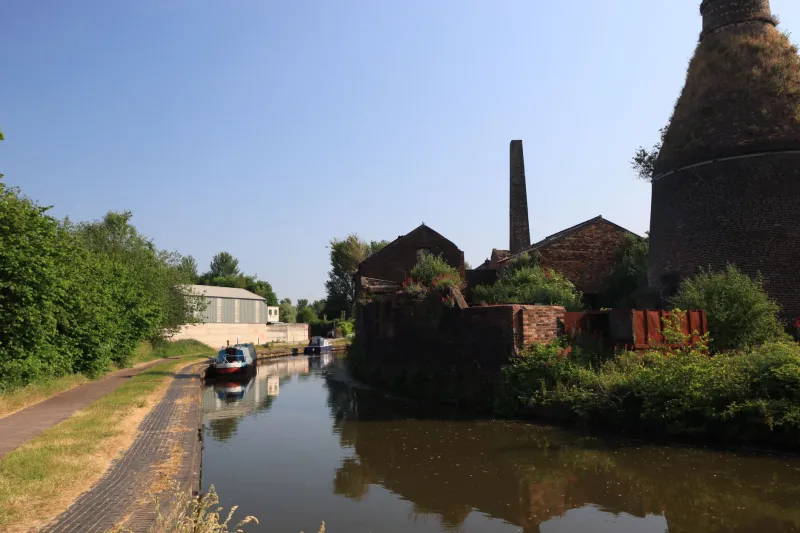
When the six towns federated in 1910, Hanley was handed the role of city centre and Burslem — the Mother Town, home of Wedgwood — was left with the architecture and the memories. The walk between them is barely a mile and a half of Waterloo Road, and it is a masterclass in how a decision made in a committee room can rearrange the fortunes of two places for a century.
The walk: Burslem's Market Place, then up past the old potbanks towards Hanley's Cultural Quarter. Go on a Saturday when both markets are running and you can feel the pull in both directions.
Getting there: Longport station for Burslem, or a bus from Stoke-on-Trent station.
Hastings, East Sussex: the Old Town and the America Ground
The Old Town is all High Street, George Street and the tarred net shops on the fishing beach — a medieval street plan that survived because nobody had a reason to knock it down. The newer centre grew up around Priory Meadow and the station, on ground that was once occupied by the celebrated America Ground, a squatter republic of sorts that declared itself outside the law in the 1820s.
The walk: twenty minutes, seafront then up. Look for the point where the shopfronts change personality — the seam is usually a change of paving.
Getting there: direct trains from London Charing Cross and Brighton.
Looe, Cornwall: two towns, one bridge
East Looe and West Looe were separate places with separate MPs until the 19th century, and they have never quite agreed to merge. East Looe has Fore Street, the quay and the fish; West Looe has the hillside, the quieter streets and a church that looks down on the whole arrangement.
The walk: cross the bridge and keep going. Ten minutes, no more, but it is the shortest foreign holiday in Britain.
Getting there: the branch line from Liskeard, which runs along the estuary and is worth the fare on its own.
Croydon, south London: north of the tram stop
Croydon's old centre is the Minster, Church Street and Surrey Street Market, which has been trading since the 13th century. The centre then marched north with the Whitgift Centre, East Croydon station and the office blocks, leaving the Old Town to be rediscovered by people who wanted a market, a decent coffee and a building older than their grandparents.
The walk: fifteen minutes from East Croydon, north to south, and the crowd changes with every block.
Getting there: fifteen minutes from Victoria.
What to look for anywhere
In every one of these towns there is a seam — a place where the crowds thin, the bins change design, the paving gives way. Find it and you have found the exact moment the centre moved. Sit on a bench on the quiet side, buy something small, and watch which way people walk. The answer is always the same: towards whatever was built last.
Then go back the other way. The old centre is usually the better walk.